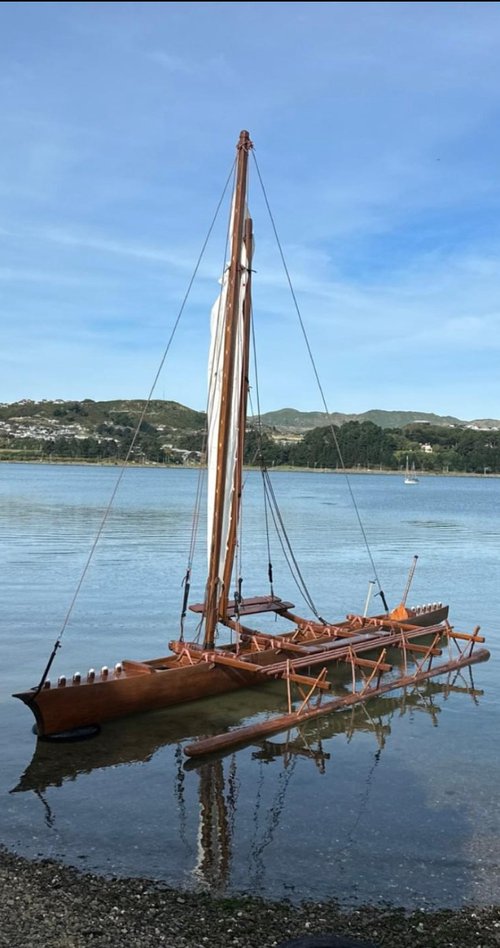
John joined the Polynesian Voyaging Society in 2009 and completed a double-hulled canoe voyage from Auckland to Tahiti, Hawai’i, Samoa, San Francisco and Mexico. A carpenter and joiner by trade, he began building his first vaka in 2017 after a long-held promise to his grandmother. Visit John in the Spine from Thursday 30 Oct – Saturday 01 Nov 11am – 1pm where he will be demonstrating how to lash toki.
Pātaka’s Claire Noble had a chat with John about his passion for building va’a.
Claire: Mālō ni John and thanks for chatting with me today. Is there a particular part of the va’a building process that you enjoy the most?
John: What I enjoy most is the conversations. It’s the conversations with knowledge holders, it’s the conversations with reading from books, it’s the conversations with my father and dare I say it, the conversations with myself! The understanding comes from those who hold knowledge. Confidence comes from making a few mistakes along the way in applying the knowledge practically. So conversations for me is part of my process in canoe building.
Claire: Can you please explain the difference between a Tokelauan vaka and a Samoan va’a?
John: It’s in the design and construction. One example is with a Samoan canoe, on the hull you don’t see stitching on the outside. On Tokelau canoes, you see the stitching come right through the hull and it is plugged up later using gum sap. I’ll be here next Thursday to Saturday lashing toki and I’ll be sharing examples.
Claire: You once said that it takes a village to raise a child, and a community to build a canoe. What did you mean by that?
John: It’s about understanding what it takes to build a canoe. The canoe is made up of different components and when put together makes a canoe. Let’s take the pandanus (tree) sail for example. There is a body of knowledge that comes with making the sail and women are predominantly the holders of that knowledge. They manage the materials, the harvesting and the preparation process. So here we see why it takes a village. When you build double hull canoes it’s a bigger village again. Crops and the likes have to be managed and prepared to feed the workers and so on. The village principal therefore becomes a very important component of any canoe build.
Claire: What do you hope the viewer experiences when they see your finished va’a?
John: My hope is that the viewers experience canoe building as a transformational art form. The tree that once stood in the forest is now a canoe on the ocean. It’s an art form that has carried our languages, our stories, our knowledge and our cultures. It’s a classroom within itself. Canoe building is an endangered art.
Photo: John Misky holding his young grandson, amongst his whanau and his finished vaka.
Claire: Are there any up-and-coming va’a builders you’re excited about?
John: What excites me most about this endangered art form is identifying potential canoe builders going forward. While I still have more to learn it’s also important part of the canoe building process to identify potential candidates. Success is succession.
Claire: Tell me about any current or future va’a building projects you’re working on.
John: On my bucket list is to go to Samoa and Tokelau and learn from the canoe builders there. We’ll see how that will unfold but it sure will make one good canoe build in the future. I’d like to build my first Tokelau canoe.
Claire: Thanks so much for your time John. I look forward to seeing you again next Thursday to Saturday 11am – 1pm in the Spine!